
1 Peter is a letter of hope to Christians who were being mocked, slandered and mistreated for their faith. Writing from Rome, which he calls Babylon, Peter addresses believers scattered across five provinces of what is now Turkey. Most of them had been pagans, and turning to Christ had cost them standing with family and neighbors. Peter reminds them who they are now: God's chosen people, born into a living hope, a holy priesthood with an inheritance that cannot fade. Then he shows them how to live as exiles in a hostile world: doing good, respecting authorities, answering insults with blessing, and following Jesus, who suffered unjustly and was raised to glory. The word "suffer" and its forms appear more often here than in any other New Testament letter.
1 Peter at a glance
| Author | Peter, an apostle of Jesus Christ, with Silvanus's help (1:1; 5:12) |
|---|---|
| Length | 5 chapters, 105 verses |
| Date and place | About AD 62–64, from Rome, called Babylon (5:13) |
| Recipients | Believers scattered in Pontus, Galatia, Cappadocia, Asia and Bithynia (1:1) |
| Main theme | Hope and holy living in the middle of suffering |
| Key verse | God in his mercy has given believers new birth into a living hope through Jesus' resurrection (1:3) |
Who wrote 1 Peter, and why?
The letter opens with Peter's name (1:1). Simon Peter was a Galilean fisherman and the leader of the twelve. Jesus gave him the name Cephas, or Peter, meaning "rock" (Matthew 16:18). He denied Jesus three times, was restored after the resurrection and told to feed Jesus' sheep (John 21:15-17), and became the leading voice of the early church in Jerusalem (Acts 2:14). The writer calls himself a fellow elder and a witness of Christ's sufferings (5:1).
The early church never questioned that Peter wrote it; Irenaeus, Tertullian and others name him. Some modern scholars doubt it, pointing to the polished Greek, the use of the Greek Old Testament, ideas close to Paul's, and the possibility that the persecution described fits a later emperor. Others answer that Greek was widely spoken in Galilee, that a fisherman with his own business was not uneducated, and that Peter says he wrote "through Silvanus," who may have shaped the wording (5:12). Silvanus is probably the Silas who traveled with Paul. Mark, whom Peter calls his son, was with him too (5:13).
Peter sends greetings from the church "in Babylon" (5:13). The book of Revelation uses Babylon as a code name for Rome (Revelation 17:5), and early tradition places Peter in Rome at the end of his life. Church tradition says he was executed there under Nero, crucified upside down, around AD 64–68. So the letter likely comes from shortly before that persecution, perhaps AD 62–64.
The readers lived in five Roman provinces in northern and western Asia Minor (1:1). Many were Gentiles. Peter mentions the empty way of life they inherited from their ancestors and the pagan parties they used to join (1:18; 4:3-4). Their neighbors now found them strange and spoke against them as evildoers (2:12; 4:4).
How 1 Peter is structured
| Section | Passage | Focus |
|---|---|---|
| Greeting and praise | 1:1-12 | Chosen exiles; a living hope; faith tested like gold |
| A new identity | 1:13 to 2:10 | Be holy; living stones; a royal priesthood |
| Living well among outsiders | 2:11 to 4:11 | Authorities, slaves, wives and husbands; suffering for doing good |
| Suffering and glory | 4:12 to 5:11 | The fiery trial; elders; humility; the devil |
| Closing | 5:12-14 | Silvanus, Mark and the church in Babylon |
1:1-12: chosen exiles with a living hope
Peter greets his readers as God's chosen people who live as exiles scattered abroad (1:1-2). Both titles come from Israel's story: Abraham called himself a foreigner in the land, and Israel was God's chosen nation. Now these Gentile believers share that identity.
He bursts into praise. In his great mercy God has given them new birth into a living hope through the resurrection of Jesus, and into an inheritance that can never spoil or fade, kept in heaven for them while God's power guards them (1:3-5). For now they may have to grieve through various trials, but these test their faith the way fire tests gold, and their proven faith will bring praise when Jesus is revealed (1:6-7). They love him though they have never seen him, and they are filled with a joy too great for words (1:8-9). The prophets searched carefully to understand this salvation, and even angels long to look into it (1:10-12).
1:13 to 2:10: a new identity
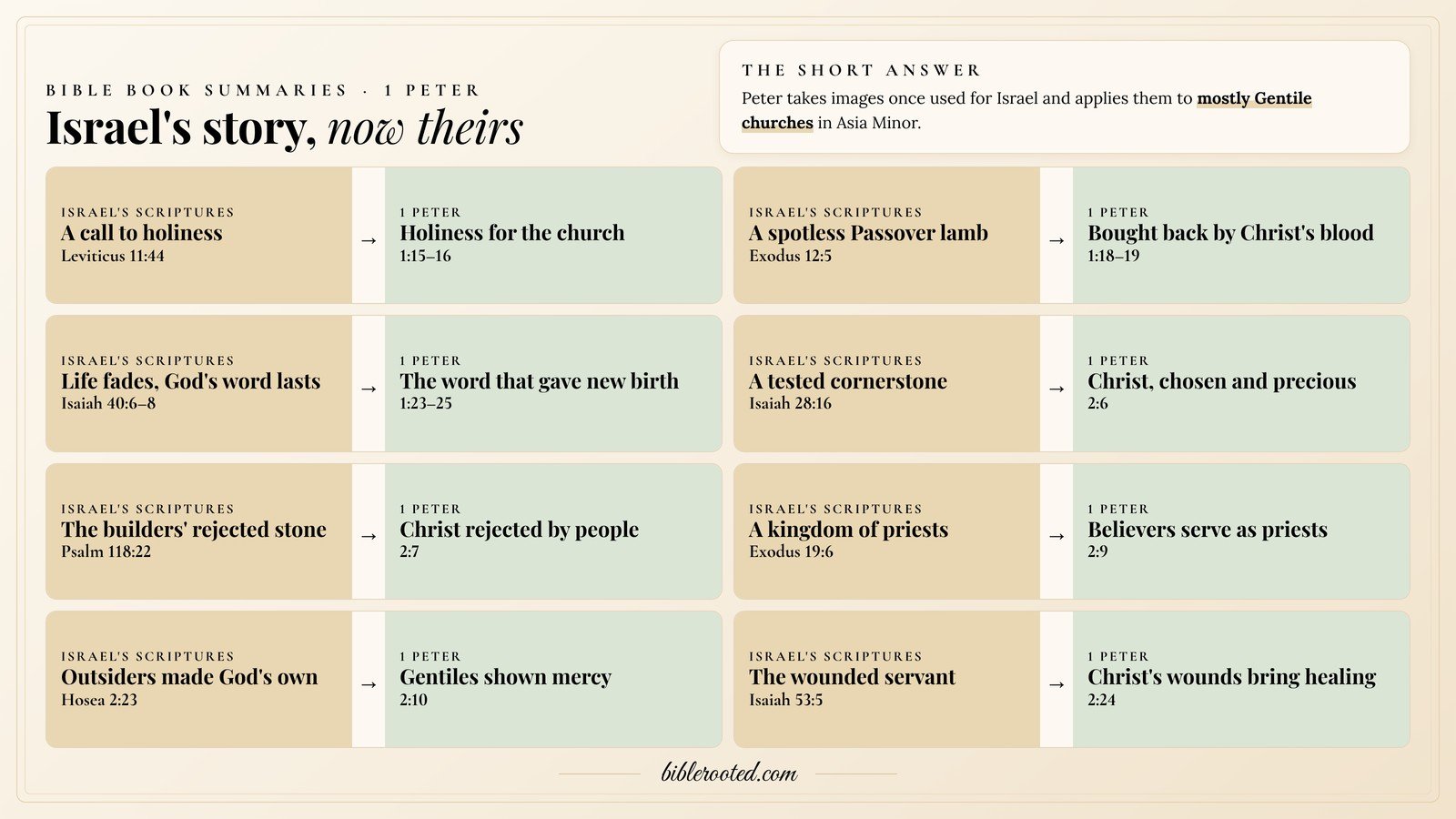
So they should prepare their minds for action, set their hope fully on the grace coming when Jesus returns, and stop living by their old desires (1:13-14). God told Israel to be holy because he is holy, and that call now applies to them (1:15-16; Leviticus 11:44). They were bought back from their empty inherited way of life not with silver or gold but with the precious blood of Christ, a lamb without defect (1:18-19). Because they have been born again through God's living word, they should love one another deeply from the heart. People wither like grass, but the Lord's word lasts forever (1:22-25; Isaiah 40:6-8).
Like newborn babies, they should crave the pure milk of the word (2:2). Christ is the living stone rejected by people but chosen by God, and they too are living stones being built into a spiritual house and a holy priesthood (2:4-5). Peter strings together Old Testament images once used for Israel: they are a chosen people, a royal priesthood, a holy nation, God's own possession, called out of darkness into his wonderful light to announce his greatness (2:9; Exodus 19:6). Once they were not a people; now they are God's people. Once they had not received mercy; now they have (2:10; Hosea 2:23).
2:11 to 3:7: good lives among outsiders
As foreigners and exiles, they should resist the desires that wage war on the soul and live such good lives among unbelievers that, though accused of wrongdoing, they will be seen doing good, and their accusers will glorify God (2:11-12). They should submit to every human authority for the Lord's sake, whether the emperor or his governors, so that doing good will silence foolish talk. They are free, but they should not use freedom as a cover for evil. Peter sums it up: respect everyone, love the family of believers, fear God and honor the emperor (2:13-17).
Household slaves should respect their masters, even harsh ones. There is no credit in being punished for doing wrong, but bearing unjust suffering pleases God (2:18-20). Christ left an example. He committed no sin, did not insult those who insulted him or threaten when he suffered, but entrusted himself to God, who judges justly. He carried our sins in his body on the cross so we could die to sin and live for what is right, and by his wounds believers are healed (2:21-24; Isaiah 53:5). They were like straying sheep, but now they have returned to their Shepherd (2:25).
Wives should accept their husbands' authority, so that unbelieving husbands may be won over without words by seeing their pure and reverent lives. Their beauty should come not from braided hair, gold or fine clothes but from the inner self, a gentle and calm spirit that God values highly (3:1-4). Husbands must be considerate, honor their wives as heirs with them of the gift of life, and know that mistreating them hinders their prayers (3:7). Readers today differ on how to apply these household instructions. Some see them as a lasting pattern for marriage; others see Peter guiding believers within the Roman household of his time, where a wife who left her husband's gods was already taking a risk.
3:8 to 4:11: suffering for doing good
All of them should be like-minded, sympathetic, loving, compassionate and humble. They must not repay evil with evil or insult with insult, but bless instead (3:8-9). If they suffer for doing what is right, they are blessed. They should not fear their opponents, but honor Christ as Lord in their hearts and always be ready to explain the hope they have, with gentleness and respect (3:14-15). It is better to suffer for doing good than for doing evil (3:17).
Christ also suffered once for sins, the righteous for the unrighteous, to bring people to God. He was put to death in the body but made alive by the Spirit (3:18). Peter then says Christ went and preached to the spirits in prison who disobeyed in Noah's day (3:19-20). This is among the most debated passages in the New Testament. Some read it as Christ announcing his victory to fallen spiritual beings after his death; others as Christ preaching through Noah to people of that time; others as Christ preaching to the dead between his death and resurrection. Peter compares the flood waters to baptism, which saves not by washing the body but as a pledge of a clear conscience toward God, through Jesus' resurrection (3:21). Christ now sits at God's right hand, with angels and powers under him (3:22).
So believers should arm themselves with the same attitude and live for God's will, not for the excess their former friends still pursue (4:1-4). The end of all things is near, so they should be clear-minded for prayer. Above all, they should love each other deeply, because love covers many sins. They should welcome one another without complaint and use whatever gift they have received to serve others (4:7-11).
4:12 to 5:11: the fiery trial
They should not be surprised at the fiery trial coming to test them, as if something strange were happening. Instead they should be glad to share in Christ's sufferings, so that they will be overjoyed when his glory is revealed (4:12-13). If they are insulted for Christ's name, God's Spirit of glory rests on them. No one should suffer as a murderer or thief, but anyone who suffers as a Christian, one of only three times the name appears in the New Testament, should not be ashamed but praise God (4:14-16). Those who suffer according to God's will should entrust themselves to their faithful Creator and keep doing good (4:19).
Peter appeals to the elders as a fellow elder. They should shepherd God's flock willingly, not for money, and lead by example, not by domineering. When the Chief Shepherd appears, they will receive a crown of glory that will never fade (5:1-4). The younger should respect the elders, and all should clothe themselves with humility, because God opposes the proud but gives grace to the humble (5:5). Humble yourselves under God's mighty hand, and he will lift you up in due time. Give him all your worries, because he cares for you (5:6-7). Be alert: the devil prowls like a hungry lion. Resist him, standing firm, knowing believers everywhere face the same suffering (5:8-9). After they have suffered a little while, the God of all grace will himself restore them and make them strong and firm (5:10-11).
5:12-14: closing
Peter says he has written briefly with Silvanus's help to encourage them and testify that this is God's true grace; they should stand firm in it (5:12). The church in Babylon and Mark send greetings, and he closes with peace (5:13-14).
1 Peter chapter by chapter
Click any chapter number to read it.
| Chapter | What it covers |
|---|---|
| 1 | A living hope; faith tested like gold; be holy; redeemed by Christ's blood |
| 2 | Living stones and a royal priesthood; honor authorities; Christ's example |
| 3 | Wives and husbands; bless instead of insult; be ready to explain your hope |
| 4 | Live for God; love deeply; the fiery trial; suffering as a Christian |
| 5 | Elders as shepherds; humility; resist the devil; final greetings |
Main themes of 1 Peter
Living hope
The resurrection gives a future that cannot fade (1:3-4).
Suffering and glory
Like Christ, believers move through suffering to glory (4:13; 5:10).
A new identity
Israel's titles now belong to the whole church (2:9-10).
Holiness
God's people reflect his character (1:15-16).
Witness through good conduct
Good lives can silence slander and win others (2:12; 3:1).
Lessons from 1 Peter
- Trials refine faith. They test it like fire tests gold (1:6-7).
- Answer insults with blessing. Do not repay evil for evil (3:9).
- Be ready to explain your hope. Do it gently and respectfully (3:15).
- Use your gifts to serve. Each person has something to give (4:10).
- Hand God your worries. He cares for you (5:7).
Frequently asked questions
What is the main point of 1 Peter?
Believers can hold on to hope and keep doing good while they suffer, because Christ suffered before he was glorified and God will restore them (1 Peter 1:3-7; 1 Peter 5:10).
Who wrote 1 Peter and why was it written?
The letter names the apostle Peter as author, writing through Silvanus from Rome (1 Peter 1:1; 1 Peter 5:12-13). Some modern scholars think a later follower wrote it. It was written to encourage persecuted believers in Asia Minor to stand firm in God's grace.
What lessons can we learn from the third chapter of 1 Peter?
Live so that others are won by your conduct, repay insults with blessing, and be ready to explain your hope with gentleness and respect (1 Peter 3:1; 1 Peter 3:9; 1 Peter 3:15).
How can I apply 1 Peter to my life?
Treat trials as tests that refine faith, use your gifts to serve others, stay humble, and hand your worries to God (1 Peter 1:6-7; 1 Peter 4:10; 1 Peter 5:6-7).
What does Babylon mean in 1 Peter?
Most scholars think it is a code name for Rome, the capital of the empire, as in Revelation (1 Peter 5:13; Revelation 17:5).
What is the most quoted verse in 1 Peter?
Many readers point to the call to always be ready to explain the hope you have (1 Peter 3:15), or the invitation to give all your worries to God because he cares for you (1 Peter 5:7).