
Revelation may be the most debated book in the Bible. Its dragons, beasts, plagues, and numbers have inspired centuries of speculation, fear, and fascination. But when you understand what kind of book it is and how its symbols work, Revelation becomes one of the most beautiful and hope-filled books in Scripture.
This guide explains Revelation step by step: its genre, its background, its structure, its major symbols, the main ways Christians interpret it, and a section-by-section walkthrough.
What kind of book is Revelation?
Revelation tells you how to read it in its very first verses, where it identifies itself in three ways.
1. An apocalypse
The book's first word in Greek is apokalypsis, meaning "unveiling" or "revelation" (Revelation 1:1). An apocalypse is a type of Jewish literature that pulls back the curtain on reality using symbolic visions. Daniel 7–12 is the most famous earlier example in the Bible, and other Jewish apocalypses were popular in John's time.
Apocalypses don't use symbols to hide meaning. They use them to reveal the true nature of things. Calling the Roman Empire a "beast," for instance, tells you something true about it that a political report couldn't.
2. A prophecy
John calls his book "the words of this prophecy" (1:3). Like the Old Testament prophets, John is a covenant messenger: he calls God's people to faithfulness, warns of judgment, and announces hope. Prophecy is less about predicting the future in detail and more about revealing God's perspective on the present in light of where history is going.
3. A letter
Revelation is addressed "to the seven churches that are in Asia" (1:4) and ends like a letter (22:21). That means it was written to real communities who were expected to understand it. Whatever Revelation means, it must have made sense to first-century Christians in Ephesus, Smyrna, and Laodicea.
Keeping all three in mind is the key to reading Revelation well. See our step-by-step guide: How to Read the Book of Revelation for Beginners.
Who wrote Revelation, when, and why?
Author. The author calls himself John, a "brother and partner in the tribulation" (1:9). Early church tradition identified him as John the apostle, though some ancient and modern scholars think he was a different John, a Christian prophet. Either way, he was a respected leader known to the churches.
Place. John received his visions while on Patmos, a small island off the coast of Asia Minor, "because of the word of God and the testimony of Jesus" (1:9), most likely a form of exile.
Date. Most scholars date the book to around AD 95, during the reign of the Roman emperor Domitian, following early church writers such as Irenaeus. Some date it earlier, to the late 60s after the persecution under Nero.
Purpose. The seven churches faced two opposite dangers. Some were suffering persecution for refusing to participate in emperor worship and pagan religion. Others were comfortable, wealthy, and compromising with the surrounding culture. Revelation addresses both: it comforts the suffering and confronts the complacent, calling everyone to "conquer" by staying faithful to Jesus, even to death.
How Revelation is structured
Revelation is carefully designed. Much of it is organized around series of seven, and its visions often overlap and repeat rather than following a strict timeline.
| Section | Chapters | Content |
|---|---|---|
| Prologue and opening vision | 1 | John sees the risen Jesus among seven lampstands |
| Seven letters | 2–3 | Jesus's messages to seven churches |
| Throne room vision | 4–5 | God on his throne; the Lamb who was slain takes the scroll |
| Seven seals | 6:1–8:1 | Judgments on a violent world; God's people sealed (ch. 7) |
| Seven trumpets | 8:2–11:19 | Warnings calling the nations to repent; the two witnesses |
| The cosmic conflict | 12–14 | The dragon, the two beasts, the Lamb and his people |
| Seven bowls | 15–16 | Final outpouring of God's justice |
| The fall of Babylon | 17–18 | The prostitute city and her collapse |
| The final victory | 19–20 | The rider on the white horse; the thousand years; final judgment |
| New creation | 21–22 | New heavens and earth; the new Jerusalem; the river of life |
Notice that the seals, trumpets, and bowls each seem to bring you to the end, then the story starts again from a new angle. Many scholars see these as overlapping views of the same period, the time between Jesus's resurrection and return, each one increasing in intensity.
Key symbols decoded
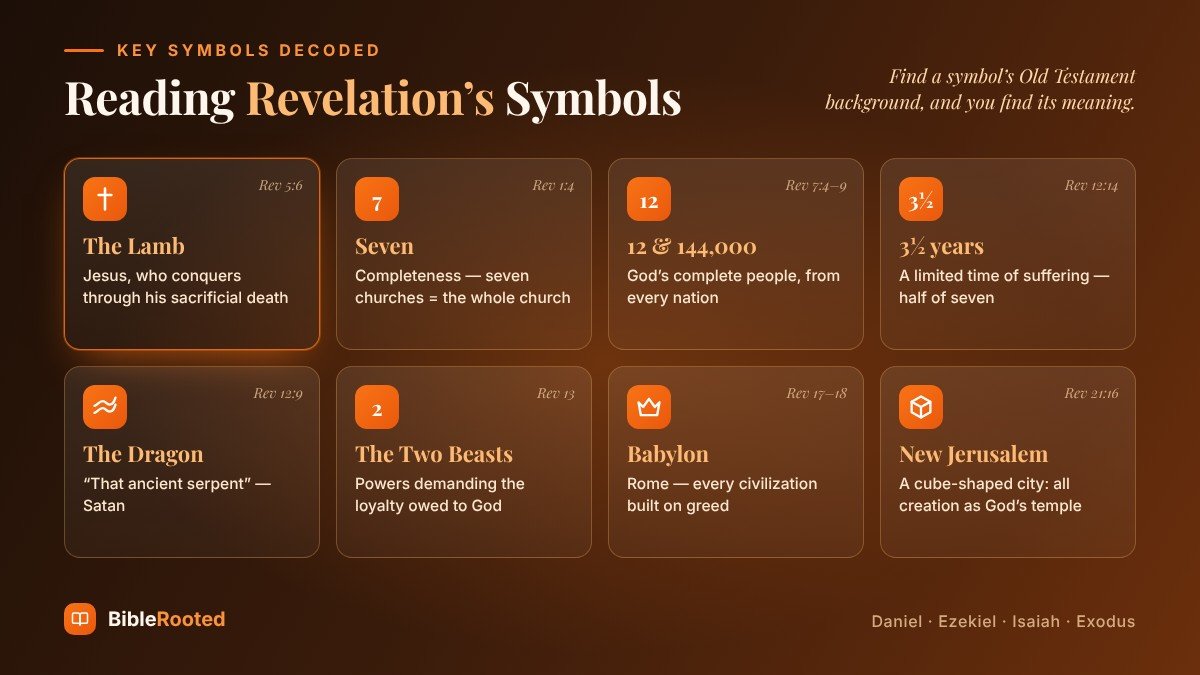
Most of Revelation's images come straight from the Old Testament. John alludes to the Hebrew Scriptures constantly, especially Daniel, Ezekiel, Isaiah, Zechariah, Exodus, and the Psalms. When you find a symbol's Old Testament background, you usually find its meaning. Revelation itself also explains several of its symbols.
The Lamb who was slain
This is the central image of the book. In chapter 5, John is told to look at "the Lion of the tribe of Judah," the conquering Messiah. He turns and sees "a Lamb, looking as if it had been slaughtered" (5:5-6). The surprise is the point: Jesus conquers not by violence but through his sacrificial death. Revelation calls him "the Lamb" 28 times.
Numbers
Numbers in Revelation are mostly symbolic:
- 7: completeness, wholeness (rooted in the seven days of creation). Seven churches stand for the whole church.
- 12: God's people (twelve tribes of Israel, twelve apostles). The new Jerusalem has twelve gates and twelve foundations (21:12-14).
- 144,000: 12 × 12 × 1,000, the complete people of God. Notably, John hears the number 144,000 from the tribes of Israel (7:4), then sees "a great multitude that no one could count, from every nation" (7:9). The same people, described two ways.
- 3½ years (also written as 42 months, 1,260 days, or "a time, times, and half a time"): a limited period of suffering, drawn from Daniel 7:25. It's half of seven, a broken, incomplete time.
- 1,000: a vast, complete period or number.
- 666: the number of the beast (13:18). See What Is the Mark of the Beast?
The dragon
The great red dragon is identified as "that ancient serpent, who is called the devil and Satan" (12:9). The image draws on the serpent of Genesis 3 and the chaos sea dragon of Old Testament poetry (see What Is Leviathan in the Bible?).
The two beasts
In chapter 13, a beast rises from the sea and another from the land. The sea beast combines features of the four beasts of Daniel 7, which represented successive empires. In John's day, it most clearly pointed to the power of Rome demanding total allegiance. The land beast promotes worship of the first beast, like the local officials and priests who promoted emperor worship. In every age, they represent political and religious systems that demand the loyalty that belongs only to God.
Babylon the great
Babylon was the empire that destroyed Jerusalem in 587 BC. In Revelation, "Babylon" is a code name for Rome (compare 1 Peter 5:13), a city drunk on wealth, luxury, and the blood of the saints (Revelation 17–18). It represents every human civilization built on greed, exploitation, and idolatry.
The new Jerusalem
The book ends with a city descending from heaven, shaped like a perfect cube (21:16), just like the Most Holy Place in Solomon's temple (1 Kings 6:20). The point: the whole new creation becomes God's temple, where he lives with his people forever. There's even a river and the tree of life, bringing the Bible's story full circle back to Eden (22:1-2).
Other common images
- Lampstands: churches (1:20).
- Stars: the angels (or messengers) of the churches (1:20).
- White robes: purity and victory through faithfulness (7:14).
- The bride: the people of God united with the Lamb (19:7-8; 21:2).
- Horns: power (from Daniel).
- Eyes: knowledge and sight (5:6).
Four main ways Christians interpret Revelation
Christians throughout history have read Revelation in different ways. Most readers today combine insights from more than one.
1. Preterist. Most of Revelation describes events in the first century, especially the conflict with Rome and the fall of Jerusalem. Strength: it takes the original audience seriously. Limitation: it can underplay the book's hope for a future new creation.
2. Historicist. Revelation predicts the history of the church from the first century to the end. Strength: it sees Revelation as relevant to all of history. Limitation: interpreters keep identifying the symbols with events of their own time, and the predictions shift.
3. Futurist. Most of Revelation (usually chapters 4–22) describes events still to come right before Jesus returns. Strength: it takes the book's future hope seriously. Limitation: it can make the book irrelevant to its first readers and lead to speculation about current events.
4. Idealist (or symbolic). Revelation portrays timeless spiritual realities: the ongoing battle between God and evil and the certainty of God's victory. Strength: it applies the book to every generation. Limitation: it can lose sight of the concrete historical setting and future hope.
Many scholars today blend these approaches: Revelation spoke directly to the first-century churches, its symbols reveal patterns that repeat throughout history, and it points forward to a real future when Jesus returns and makes all things new.
What about the millennium?
Revelation 20 describes a thousand-year reign of Christ. Christians hold three main views:
- Premillennial: Jesus returns before a literal thousand-year reign on earth.
- Postmillennial: the gospel's spread brings a long era of peace, after which Jesus returns.
- Amillennial: the thousand years symbolize the current reign of Christ, from his resurrection to his return.
Faithful Christians have held each of these views throughout church history.
Revelation section by section
Chapter 1: The risen Jesus
John sees Jesus standing among seven golden lampstands, glorious and terrifying, with a description drawn from Daniel 7 and 10. Jesus says, "Do not be afraid. I am the First and the Last. I am the Living One; I was dead, and now look, I am alive for ever and ever!" (1:17-18). Everything that follows flows from this vision.
Chapters 2–3: Seven letters
Jesus addresses each church specifically, praising faithfulness and confronting compromise. Ephesus has lost its first love. Smyrna is poor and persecuted but spiritually rich. Laodicea is wealthy, comfortable, and "lukewarm." Each letter ends with a promise "to the one who conquers," and these promises are fulfilled in the new creation of chapters 21–22.
Chapters 4–5: The throne and the Lamb
John is taken into God's heavenly throne room, where all creation worships the Creator. A scroll sealed with seven seals, representing God's plan for history, can only be opened by the slaughtered Lamb. The heavenly choir sings that by his blood, he has ransomed people "from every tribe and language and people and nation" (5:9). This is the theological center of the book.
Chapters 6–11: Seals and trumpets
As the Lamb opens the seals, the four horsemen bring conquest, war, famine, and death, depicting the violence of human empires that God allows to run its course. Between the sixth and seventh seals, there's a pause to show God's people sealed and protected (ch. 7). The trumpets echo the plagues of Egypt, calling the nations to repent. Chapter 11's two witnesses picture the church's faithful testimony, which leads to suffering but ultimately to vindication.
Chapters 12–14: The cosmic conflict
The curtain pulls back further. A woman gives birth to a child who will rule the nations, and a dragon tries to devour him (ch. 12). This is the story of Jesus told as cosmic drama. Defeated in heaven, the dragon wages war on the woman's other children through two beasts (ch. 13). But then John sees the Lamb standing on Mount Zion with his people (ch. 14). The church conquers "by the blood of the Lamb and by the word of their testimony" (12:11).
Chapters 15–16: The bowls
The final cycle of judgment echoes the exodus. God's people sing "the song of Moses and of the Lamb" (15:3) as justice is poured out on the beast's kingdom. Even here, the text notes that people "did not repent" (16:9, 11), showing that the judgments are meant to lead to repentance.
Chapters 17–18: Babylon falls
Babylon appears as a prostitute riding the beast, seductive and violent. Then she falls. Kings and merchants mourn the loss of their wealth (ch. 18), while God's people are told to "come out of her" (18:4) and refuse to participate in her sins.
Chapters 19–20: The final victory
Heaven rejoices, and the wedding of the Lamb is announced. Jesus rides out on a white horse, but his robe is already dipped in blood before the battle begins (19:13), and he conquers with a sword from his mouth: his word. Satan is bound, the faithful reign with Christ, and evil is finally defeated. The dead are judged, and death itself is destroyed (20:14).
Chapters 21–22: All things new
The book ends with the most hopeful vision in the Bible: "Look! God's dwelling place is now among the people, and he will dwell with them... He will wipe every tear from their eyes. There will be no more death or mourning or crying or pain" (21:3-4). Heaven and earth are reunited, the tree of life returns, and God's people see his face (22:4). The Bible's story that began in a garden ends in a garden-city.
How Revelation completes Genesis
Revelation is the final chapter of a story that began in Genesis, and its last two chapters deliberately echo the Bible's first pages. Read them side by side:
| Genesis 1–3 | Revelation 21–22 |
|---|---|
| God creates the heavens and the earth (Gen 1:1) | "A new heaven and a new earth" (Rev 21:1) |
| God separates light from darkness, creates the sun (Gen 1:3, 16) | The city "has no need of sun or moon," for God's glory gives it light (21:23; 22:5) |
| A river flows out of Eden (Gen 2:10) | "The river of the water of life" flows from God's throne (22:1) |
| The tree of life in the garden (Gen 2:9) | The tree of life, whose leaves heal the nations (22:2) |
| The land around Eden has gold and precious stones (Gen 2:11-12) | The city is built of gold and precious stones (21:18-21) |
| The serpent deceives humanity (Gen 3:1-5) | The ancient serpent is destroyed (20:2, 10) |
| The curse falls on the ground (Gen 3:17) | "No longer will there be anything accursed" (22:3) |
| Humans are exiled from God's presence (Gen 3:23-24) | "They will see his face" (22:4) |
The point is clear: God isn't abandoning his original creation. He's finishing what he started. The garden has grown into a garden-city, filled with people from every nation, and heaven and earth are finally united. This is why Revelation makes the most sense when you know the rest of the Bible's story.
The songs of Revelation
One of the most overlooked features of Revelation is how much singing it contains. The visions are regularly interrupted by worship songs in heaven, and these songs interpret what's happening:
- 4:8, 11: The living creatures and elders worship God as holy Creator.
- 5:9-10, 12-13: A "new song" celebrates the Lamb who was slain and ransomed people from every nation.
- 7:10, 12: The great multitude praises God for salvation.
- 11:15-18: Heaven announces that "the kingdom of the world has become the kingdom of our Lord and of his Christ."
- 15:3-4: The "song of Moses and of the Lamb" celebrates God's justice.
- 19:1-8: A fourfold "Hallelujah" celebrates the fall of Babylon and the wedding of the Lamb.
Many classic hymns and worship songs draw their words from these passages. For John's first readers, the songs were a form of resistance. In a world that demanded worship of Caesar, the churches sang that only God and the Lamb are worthy.
Why Revelation is a book of hope
It's easy to come away from Revelation with fear. But the book was written to produce courage and worship. It reminds us that:
- Jesus is already victorious. The decisive battle was won at the cross and empty tomb.
- Evil is real but limited. Its time is short (three and a half years, half of seven).
- Faithfulness matters. God's people overcome by staying loyal to Jesus, not by fighting with the world's weapons.
- God is making all things new. The story ends not with escape from creation but with its renewal.
Revelation is also the only book of the Bible that promises a blessing to those who read it (1:3), and it contains seven "blessed are" statements in total, from 1:3 to 22:14.
Frequently asked questions
Is Revelation meant to be taken literally?
Revelation uses literal language about real events and realities, such as Jesus's return, judgment, and new creation, but it communicates them through symbols. John tells us some symbols are symbols (1:20; 12:9; 17:9, 18). Reading every image as literal misreads the genre.
Is the book called Revelation or Revelations?
It's "Revelation," singular. The title comes from the first verse: "The revelation of Jesus Christ" (1:1).
Who is the antichrist in Revelation?
The word "antichrist" doesn't appear in Revelation. It appears only in 1 and 2 John, where it refers to anyone who denies Jesus, and John says "many antichrists have come" (1 John 2:18). The beasts of Revelation 13 are often associated with the idea.
Does Revelation describe the rapture?
Revelation doesn't describe a rapture of believers in clear terms. Belief in a rapture before the tribulation draws mostly on other texts, like 1 Thessalonians 4, and on certain readings of Revelation. Christians disagree about this.
What is the main message of Revelation?
Jesus, the slaughtered and risen Lamb, reigns over history. Evil will be defeated, God will renew creation and live with his people, and so his followers should stay faithful no matter the cost.