
Acts is the second half of Luke's two-part work and the only history of the first Christian generation in the Bible. It opens with the risen Jesus, forty days after Easter, telling his followers to wait for the Holy Spirit, and it closes about thirty years later with Paul under house arrest in Rome, still teaching. In between, a small Jewish group in Jerusalem becomes a movement of Jews and Gentiles across the Roman Empire. Peter leads the first half and Paul the second, but Luke's opening line suggests the real subject: what Jesus went on doing through his Spirit and his people.
Acts at a glance
| Author | Luke, the doctor and companion of Paul (Colossians 4:14) |
|---|---|
| Length | 28 chapters, about 1,000 verses |
| Date | About AD 62 (traditional) or AD 80–90 (many scholars) |
| Period covered | About AD 30 to 62 |
| Main figures | Peter (chapters 1–12) and Paul (chapters 13–28) |
| Places | From Jerusalem to Rome |
| Key verse | The Spirit will give the disciples power to be Jesus' witnesses from Jerusalem to the ends of the earth (1:8) |
Who wrote Acts, and why?
Acts opens by reminding Theophilus of an earlier book about everything Jesus began to do and teach (1:1). That earlier book is Luke, which is addressed to the same man (Luke 1:3). Four passages slip from "they" into "we", placing the writer with Paul at Philippi, on the way to Jerusalem and on the voyage to Rome (16:10; 20:6; 21:17; 27:1). From the second century on, church writers named him as Luke, the doctor Paul mentions as one of his coworkers (Colossians 4:14; Philemon 1:24).
The book stops with Paul living for two years in a rented house in Rome, welcoming visitors and preaching openly (28:30-31). It says nothing about the outcome of his trial, Nero's persecution or Paul's death, so many date it around AD 62. Others place it in AD 80–90, after Luke's Gospel. Either way the purpose is plain. Luke shows how the message moved from Jerusalem to Rome, why Gentiles were welcomed without becoming Jews, and that Roman officials found nothing criminal in it.
How Acts is structured
Jesus' last words before his ascension work as a table of contents. The disciples will be his witnesses in Jerusalem, then in Judea and Samaria, then to the ends of the earth (1:8). Luke also marks stages with short notes that the word of God kept spreading (6:7; 9:31; 12:24; 16:5; 19:20; 28:31).
| Stage | Passage | Main events |
|---|---|---|
| Jerusalem | 1:1 to 8:3 | Ascension, Pentecost, the first church, Stephen |
| Judea and Samaria | 8:4 to 12:25 | Philip, Saul's conversion, Cornelius, Antioch |
| To the ends of the earth | 13:1 to 28:31 | Paul's journeys, arrest, trials, Rome |
chapters 1–2: ascension and Pentecost
For forty days the risen Jesus appears to the apostles and speaks about God's kingdom (1:3). He promises they will receive power when the Holy Spirit comes on them, and then a cloud takes him from their sight (1:8-9). Two men in white say he will return the same way (1:11). About 120 believers wait and pray, and Matthias is chosen by lot to replace Judas (1:15; 1:26).
At the harvest festival of Pentecost the Spirit arrives with a sound like a rushing wind and what look like flames resting on each of them (2:1-3). They begin speaking in other languages, and Jewish pilgrims from Parthia to Rome hear God's great deeds in their own tongues (2:4-11). Peter explains that this is what the prophet Joel foretold (2:16). God raised the crucified Jesus, because death could not keep its hold on him, and has made him Lord and Messiah (2:24; 2:36). Cut to the heart, the crowd asks what to do. Peter tells them to turn back to God and be baptized in Jesus' name for forgiveness, and they will receive the Spirit too (2:37-38). About three thousand are baptized that day (2:41). They devote themselves to teaching, shared meals and prayer, and share their goods with anyone in need (2:42-45).
chapters 3–7: the church in Jerusalem
At the temple gate at three in the afternoon, the hour of prayer, Peter tells a man lame from birth that he has no money but heals him in Jesus' name, and the man goes leaping into the temple (3:1-8). Peter and John are arrested. Before the council Peter says salvation comes through no other name, and the leaders are amazed that ordinary, untrained men speak so boldly (4:12-13). Ordered to stop, they answer that they cannot stay quiet about what they have seen and heard (4:19-20).
The believers share everything. Barnabas, a Levite from Cyprus, sells a field and gives the money (4:32-37). Ananias and Sapphira lie about their gift and both fall dead (5:1-10). The apostles are jailed again, freed by an angel, and told once more to be silent. They reply that God's orders come first (5:18-29). The teacher Gamaliel warns that if this movement is from God, no one can stop it (5:34-39). The apostles leave rejoicing that they were counted worthy to suffer (5:41).
When Greek-speaking widows are overlooked in the daily food distribution, the church appoints seven men to run it, Stephen and Philip among them (6:1-5). Stephen is accused of speaking against the temple. In a long speech he retells Israel's history and accuses the leaders of resisting God like their ancestors (7:2). Furious, they drag him out and stone him. He sees Jesus standing at God's right hand, prays for his killers and dies. The witnesses leave their coats at the feet of a young man named Saul (7:55-60).
chapters 8–12: Samaria, Saul and the Gentiles
Saul approves of the killing and starts dragging believers from their homes. The church scatters, and everywhere they go they spread the message (8:1-4). Philip preaches in Samaria, and Peter and John come down to pray for the new believers to receive the Spirit (8:5; 8:14-17). On the desert road to Gaza, Philip meets an Ethiopian court official reading Isaiah, explains the passage, and baptizes him (8:26-38).
On his way to arrest believers in Damascus, Saul is struck down by a light from heaven, and a voice asks why he is persecuting him. It is Jesus (9:3-5). Blind for three days, Saul is healed and baptized when a disciple named Ananias lays hands on him, and he begins preaching that Jesus is the Son of God (9:9; 9:18-20). He escapes a plot by being lowered over the city wall in a basket, and in Jerusalem Barnabas vouches for him when the others are afraid (9:25-27).
Peter raises Tabitha at Joppa (9:40). At Caesarea a Roman officer named Cornelius sees an angel during his afternoon prayers (10:1-3). On a rooftop Peter sees a sheet full of animals and hears that he must not call unclean what God has made clean (10:9-15). At Cornelius's house he realizes God shows no favoritism, and while he is still speaking the Spirit falls on the Gentile listeners (10:34-35; 10:44-45). The Jerusalem church accepts that God has given Gentiles repentance that leads to life (11:18). In Antioch the church grows among Greeks, Barnabas brings Saul to teach there, and the disciples are first called Christians (11:20-26). Herod Agrippa kills James, John's brother, and jails Peter, but an angel leads Peter out while the church prays. Herod soon dies, and the word keeps growing (12:1-7; 12:23-24).
chapters 13–20: Paul's journeys
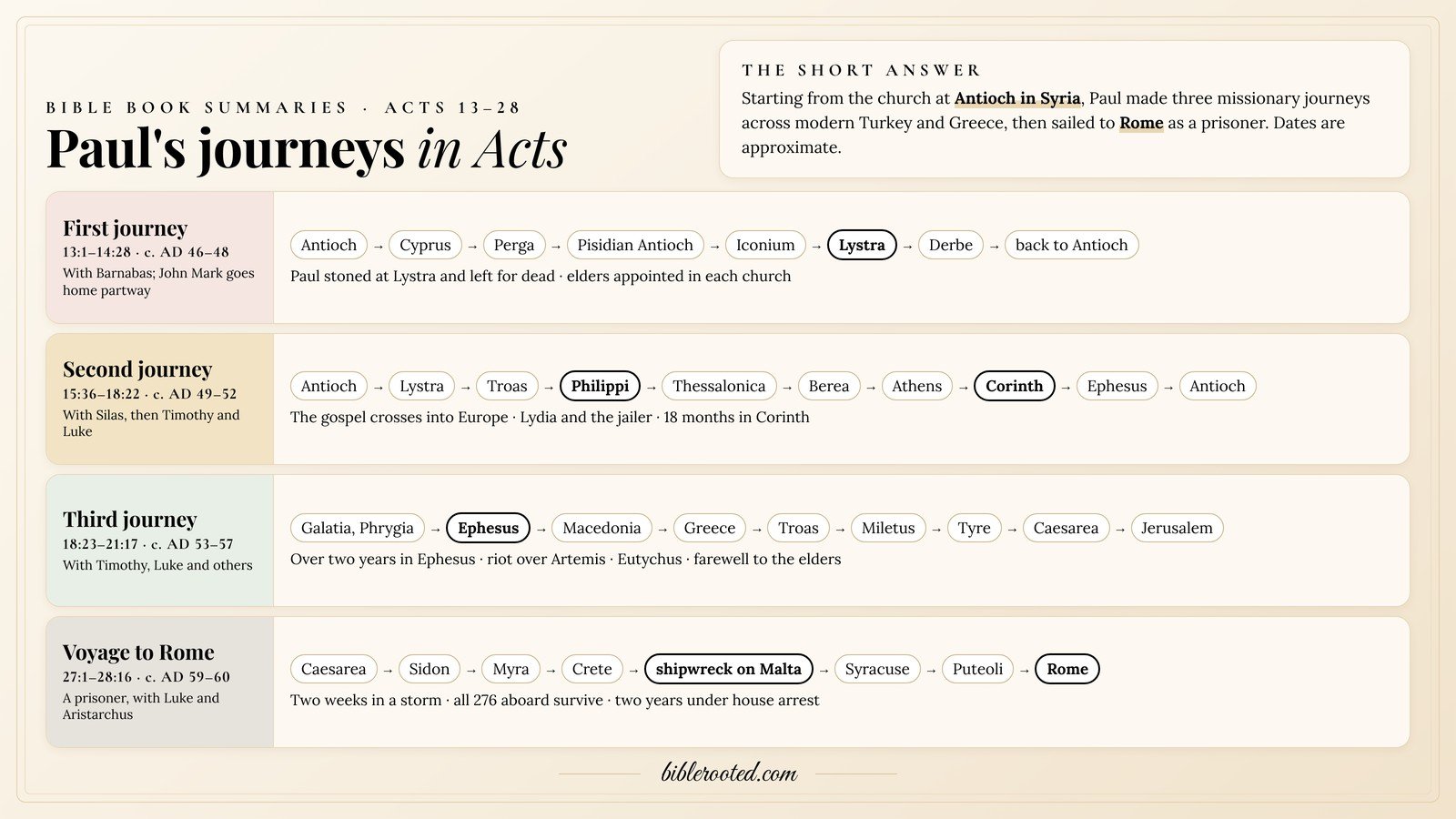
The Spirit tells the Antioch church to set apart Barnabas and Saul, now called Paul, for the work he has for them (13:2; 13:9). On the first journey they cross Cyprus and the highlands of Asia Minor. Paul preaches first in synagogues, and when many there reject him he turns to the Gentiles (13:14; 13:46-47). At Lystra the crowd calls them Zeus and Hermes, then stones Paul and leaves him for dead (14:11-12; 14:19). They appoint elders in each new church and return home (14:23; 14:26).
The big question then reaches Jerusalem: must Gentile believers be circumcised and keep the law of Moses (15:1)? Peter reminds the council that Jews and Gentiles alike are saved by the grace of the Lord Jesus (15:11). James proposes not to burden the Gentiles but to ask them to avoid a few practices that would offend Jewish believers (15:19-20). A letter goes out, and the decision opens the way for a church of many nations (15:28).
Paul and Barnabas split over John Mark, and Paul sets out with Silas (15:39-40). Timothy joins them, and a vision of a man calling for help draws them across into Macedonia, in Europe (16:1; 16:9-10). At Philippi a businesswoman named Lydia believes (16:14). Paul and Silas are beaten and jailed, sing hymns at midnight, and an earthquake opens the doors. The jailer asks how to be saved and is told to trust in the Lord Jesus (16:22-31). In Athens Paul speaks to philosophers about an altar to an unknown god and about the God in whom all people live and move (17:22-28). In Corinth he makes tents with Aquila and Priscilla and stays eighteen months (18:2-3; 18:11).
On the third journey Paul spends over two years in Ephesus, until everyone in the province of Asia has heard the message (19:10). Magic books worth fifty thousand silver coins are burned, and silversmiths who make shrines for the goddess Artemis start a riot (19:19; 19:28-29). At Troas a young man named Eutychus falls asleep during Paul's long sermon, drops from a window and is restored to life (20:9-10). At Miletus Paul says farewell to the Ephesian elders, reminding them of Jesus' words that giving brings more blessing than receiving (20:17; 20:35).
chapters 21–28: prisoner to Rome
Friends and the prophet Agabus warn Paul that chains wait in Jerusalem, but he says he is ready to die for the Lord Jesus (21:10-13). In the temple a mob seizes him, and Roman soldiers rescue him just in time (21:27-33). He tells the crowd his story, and when soldiers prepare to flog him he reveals he is a Roman citizen (22:1-6; 22:25). The Lord stands by him at night and tells him he must testify in Rome too (23:11). After his nephew uncovers a plot by forty men, he is moved under heavy guard to Caesarea (23:16; 23:23).
Governor Felix hears him and trembles at talk of judgment, but leaves him in prison for two years (24:25; 24:27). Under Festus, Paul appeals to Caesar (25:11-12). He tells King Agrippa how he met Jesus, and Agrippa admits Paul might have been freed if he had not appealed (26:28; 26:32). A storm batters the ship for two weeks, and Paul tells the 276 aboard that God has promised none will die. The ship breaks up off Malta, and everyone reaches shore (27:14; 27:23-24; 27:37; 27:44). A viper bite leaves Paul unharmed, and he heals the island's sick (28:3-8). In Rome he lives under guard for two years, welcoming everyone and teaching about Jesus boldly with no one stopping him (28:16; 28:30-31).
Acts chapter by chapter
Click any chapter number to read it.
| Chapter | What it covers |
|---|---|
| 1 | Ascension; Matthias chosen |
| 2 | Pentecost; Peter's sermon; the first church |
| 3 | Lame man healed; Peter preaches |
| 4 | Before the council; shared possessions |
| 5 | Ananias and Sapphira; apostles jailed |
| 6 | Seven chosen; Stephen arrested |
| 7 | Stephen's speech and death |
| 8 | Persecution; Samaria; Ethiopian official |
| 9 | Saul's conversion; Tabitha raised |
| 10 | Peter's vision; Cornelius |
| 11 | Gentiles accepted; church at Antioch |
| 12 | James killed; Peter freed; Herod dies |
| 13 | First journey: Cyprus, Pisidian Antioch |
| 14 | Iconium, Lystra, Derbe; return |
| 15 | Jerusalem council; Paul and Barnabas part |
| 16 | Timothy; Macedonian call; Philippi |
| 17 | Thessalonica, Berea, Athens |
| 18 | Corinth; Apollos |
| 19 | Ephesus; riot over Artemis |
| 20 | Eutychus; farewell at Miletus |
| 21 | Agabus' warning; arrest in the temple |
| 22 | Paul's defense; Roman citizen |
| 23 | Before the council; plot; to Caesarea |
| 24 | Trial before Felix |
| 25 | Festus; appeal to Caesar |
| 26 | Paul before Agrippa |
| 27 | Storm and shipwreck |
| 28 | Malta; Paul in Rome |
Main themes of Acts
The Holy Spirit
The Spirit empowers, guides and sends the church (2:4; 13:2).
Witness to the world
The message spreads from Jerusalem to Rome (1:8; 28:31).
The resurrection
Every major sermon centers on the risen Jesus (2:24; 17:31).
Jews and Gentiles together
God accepts people from every nation (10:34-35; 15:11).
Growth through suffering
Persecution scatters the church and spreads the word (8:4; 14:22).
Lessons from Acts
- Pray together. The church prayed before every big step (1:14; 12:5).
- Share generously. No one among them was in need (4:34).
- Speak with courage. Ordinary people spoke boldly (4:13).
- Welcome outsiders. God made no distinction (15:9).
- Keep going. Paul finished his course with joy (20:24).
Frequently asked questions
What is the main message of the book of Acts?
The risen Jesus, through the Holy Spirit, sends his followers to be his witnesses everywhere (Acts 1:8), and nothing can stop the spread of the message (Acts 5:39; Acts 28:31).
What are the five main ideas of the book of Acts?
The Holy Spirit's power (Acts 2:4), witness to the whole world (Acts 1:8), the resurrection of Jesus (Acts 2:24), Jews and Gentiles in one church (Acts 10:34-35), and growth through persecution (Acts 8:4).
Why is 3AM God's hour?
Who wrote the book of Acts and why?
Luke, Paul's coworker and a doctor, wrote it as the second volume of his Gospel (Acts 1:1; Colossians 4:14). He wanted to show how the message of Jesus spread from Jerusalem to Rome and welcomed Gentiles.
How many missionary journeys did Paul make in Acts?
Three, plus his voyage to Rome as a prisoner. They begin at Acts 13:2, Acts 15:40 and Acts 18:23, and the voyage at Acts 27:1.
How many chapters are in Acts?
Acts has 28 chapters, covering about 30 years from Jesus' ascension to Paul's house arrest in Rome.