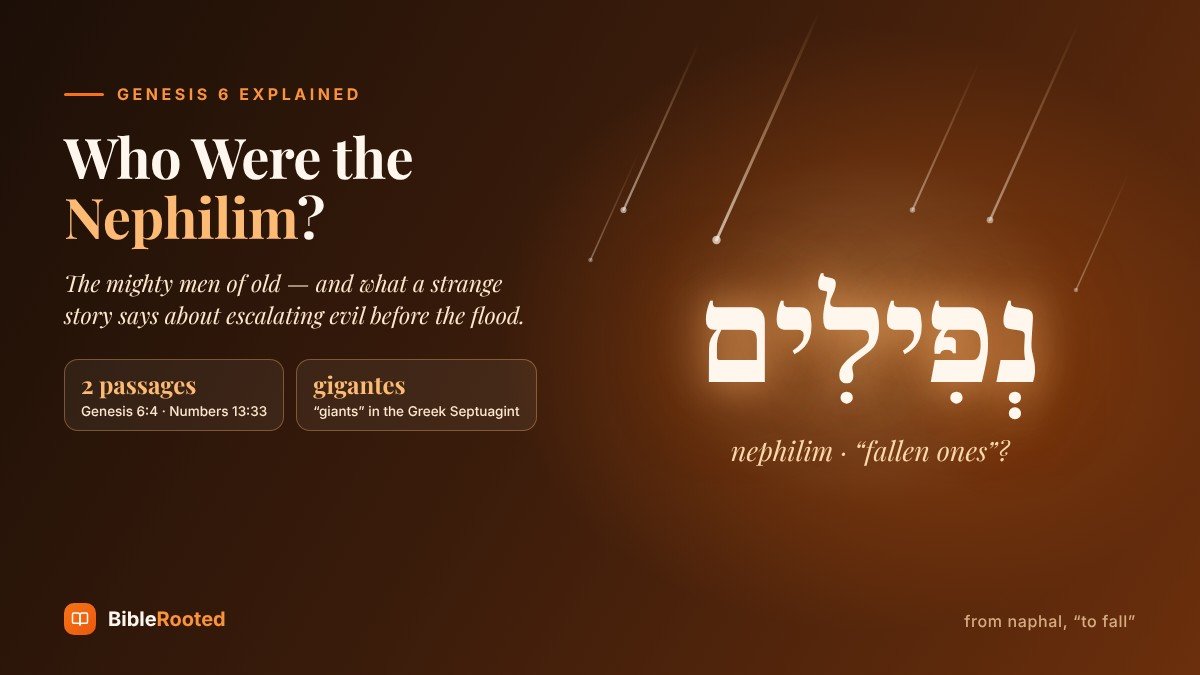
The two Nephilim passages
The Nephilim are mentioned in only two places in the Bible.
Genesis 6:1-4. Right before the flood story, Genesis says that "the sons of God saw that the daughters of man were attractive. And they took as their wives any they chose" (6:2). God responds by limiting human lifespans (6:3). Then the narrator adds: "The Nephilim were on the earth in those days, and also afterward, when the sons of God came in to the daughters of man and they bore children to them. These were the mighty men [gibborim] who were of old, the men of renown" (6:4).
Numbers 13:33. Centuries later, when Moses sends spies into Canaan, they return terrified: "We saw the Nephilim there (the sons of Anak come from the Nephilim), and we seemed to ourselves like grasshoppers, and so we seemed to them."
What does "Nephilim" mean?
The name likely comes from the Hebrew verb naphal, "to fall," so it might mean "fallen ones" or "those who fall upon others" (i.e., attackers). The ancient Greek translation of the Old Testament, the Septuagint, rendered it gigantes, "giants," which is why older English Bibles say "There were giants in the earth in those days" (Genesis 6:4, KJV).
Three views of the "sons of God"
The key question is who "the sons of God" were. There are three main interpretations.
1. Rebellious spiritual beings
Elsewhere in the Hebrew Bible, "sons of God" refers to heavenly beings in God's council (Job 1:6; 2:1; 38:7; compare Psalm 82). On this view, Genesis 6 describes spiritual beings crossing a boundary God set, uniting with human women, and producing the Nephilim.
This was the most common view among early Jewish interpreters and the earliest Christian writers. The Jewish book of 1 Enoch, widely read in Jesus's day, expands the story in detail, describing rebellious "Watchers" who descended to earth. The New Testament letters of 2 Peter and Jude appear to allude to this tradition, describing angels who sinned and "did not stay within their own position of authority" and are now kept "in eternal chains" (Jude 6; compare 2 Peter 2:4-5, which mentions these angels right before the flood).
2. The descendants of Seth
From the fourth and fifth centuries, many Christian interpreters, including Augustine, argued that the "sons of God" were the godly descendants of Adam's son Seth (Genesis 5), and the "daughters of man" were the ungodly descendants of Cain (Genesis 4). The sin, then, was intermarriage between the faithful and unfaithful lines.
This view avoids the difficulty of spiritual beings having children with humans (some point to Jesus's statement that angels "neither marry nor are given in marriage," Matthew 22:30, though that refers to angels in heaven). Critics note that Genesis never calls Seth's line "sons of God."
3. Powerful human rulers
Some ancient Jewish interpreters understood "sons of God" as kings or nobles, since ancient rulers were often called sons of gods. On this view, Genesis 6 describes tyrants who took women by force, building harems and dynasties of violent "mighty men."
This fits the emphasis in Genesis 6 on violence and power. It also connects to the pattern in Genesis 4 of Lamech, who takes two wives and boasts of violence.
Which view is right?
Faithful readers have held each of these views. The first has the strongest support from how the phrase "sons of God" is used elsewhere in the Hebrew Bible and how the earliest interpreters read it. But all three views agree on the passage's main point: humanity's corruption was escalating out of control.

The Nephilim and the giants of Canaan
After the flood, the name "Nephilim" resurfaces in Numbers 13:33, attached to the Anakim, a tall people living in Canaan. Deuteronomy mentions other giant clans, the Rephaim, Emim, and Zamzummim (Deuteronomy 2:10-11, 20-21), and King Og of Bashan, "the last of the remnant of the Rephaim," whose bed was nine cubits (about 13 feet) long (Deuteronomy 3:11).
How could the Nephilim exist after the flood? The spies may simply have used "Nephilim" as a legendary label to express their fear, much like calling someone a "titan." Genesis 6:4 itself says they were on earth "in those days, and also afterward," which may anticipate this later use.
The giant theme continues: Joshua 11:22 says the Anakim survived in Gaza, Gath, and Ashdod. Goliath, the giant David defeats, came from Gath (1 Samuel 17:4).
Why is this story in the Bible?
The Nephilim story isn't there to satisfy our curiosity. It plays a role in the larger narrative of Genesis 1–11, which traces how human evil spreads after the rebellion in Eden.
In Genesis 3, humans grasp at divine knowledge. In Genesis 4, Cain murders Abel and violence multiplies. In Genesis 6, the boundaries between heaven and earth are violated, and "mighty men" fill the earth. Immediately afterward, God sees that "the wickedness of man was great in the earth" and "the earth was filled with violence" (Genesis 6:5, 11). The flood is God's response.
The story also sets up a pattern that continues throughout the Bible: oppressive powers grasping for status and control, and God bringing them down. Even giants like Goliath fall when God's people trust him.
Frequently asked questions
Were the Nephilim giants?
Numbers 13:33 describes them as enormous compared to the Israelites, and the Greek translation called them "giants." Genesis 6:4 emphasizes that they were "mighty men" and "men of renown," which may point more to power and fame than to physical size.
Are the Nephilim in the Book of Enoch?
Yes. 1 Enoch, a Jewish writing from before the time of Jesus, describes the Watchers (rebellious angels) fathering giants and teaching humans forbidden knowledge. It's not part of most Bibles, though the Ethiopian Orthodox Church includes it, and Jude 14-15 quotes it.
Did the Nephilim survive the flood?
Genesis presents the flood as wiping out all life outside the ark. The later use of "Nephilim" in Numbers 13 is likely a description of other giant peoples, not literal survivors.
Are there Nephilim today?
No. The Bible connects the Nephilim to specific ancient periods, and nothing in Scripture suggests they exist today.