
The words for forgiveness
The biblical languages use several images to describe forgiveness.
Hebrew:
- Salach: to forgive or pardon. In the Hebrew Bible, God is always the subject of this verb. It's something only God does in this full sense.
- Nasa: to lift up or carry away. When God forgives, he lifts the weight of sin off of a person or bears it himself (Exodus 34:7; Psalm 32:1).
- Kaphar: to cover or ransom, the word behind "atonement." In Leviticus, sacrifices made atonement, dealing with sin so that relationship with God could be restored.
Greek:
- Aphiēmi: to release, let go, or cancel. It's used for canceling debts and releasing prisoners, as well as for forgiving sins.
- Charizomai: to give freely or show grace. "Forgiving one another, as God in Christ forgave you" (Ephesians 4:32).
Taken together, these words picture forgiveness as lifting a burden, covering a stain, and canceling a debt.
How God forgives
From the beginning, the Bible presents God as a forgiving God. After Israel's golden calf rebellion, God describes himself as "merciful and gracious, slow to anger, and abounding in steadfast love and faithfulness... forgiving iniquity and transgression and sin" (Exodus 34:6-7). That forgiveness flows from his hesed, his loyal love (see What Does Hesed Mean?).
The Psalms and prophets celebrate how complete God's forgiveness is:
- "As far as the east is from the west, so far does he remove our transgressions from us" (Psalm 103:12).
- "You will cast all our sins into the depths of the sea" (Micah 7:19).
- In the new covenant, God promises, "I will forgive their iniquity, and I will remember their sin no more" (Jeremiah 31:34).
In the New Testament, forgiveness comes through Jesus. At the Last Supper, he describes his blood as "poured out for many for the forgiveness of sins" (Matthew 26:28). On the cross, he prays, "Father, forgive them, for they know not what they do" (Luke 23:34).
What Jesus taught about forgiving others
Jesus made forgiveness central to the life of his followers.
In the Lord's Prayer. Jesus teaches his disciples to pray, "Forgive us our debts, as we also have forgiven our debtors" (Matthew 6:12). Right after the prayer, he says that those who refuse to forgive others won't be forgiven (6:14-15).
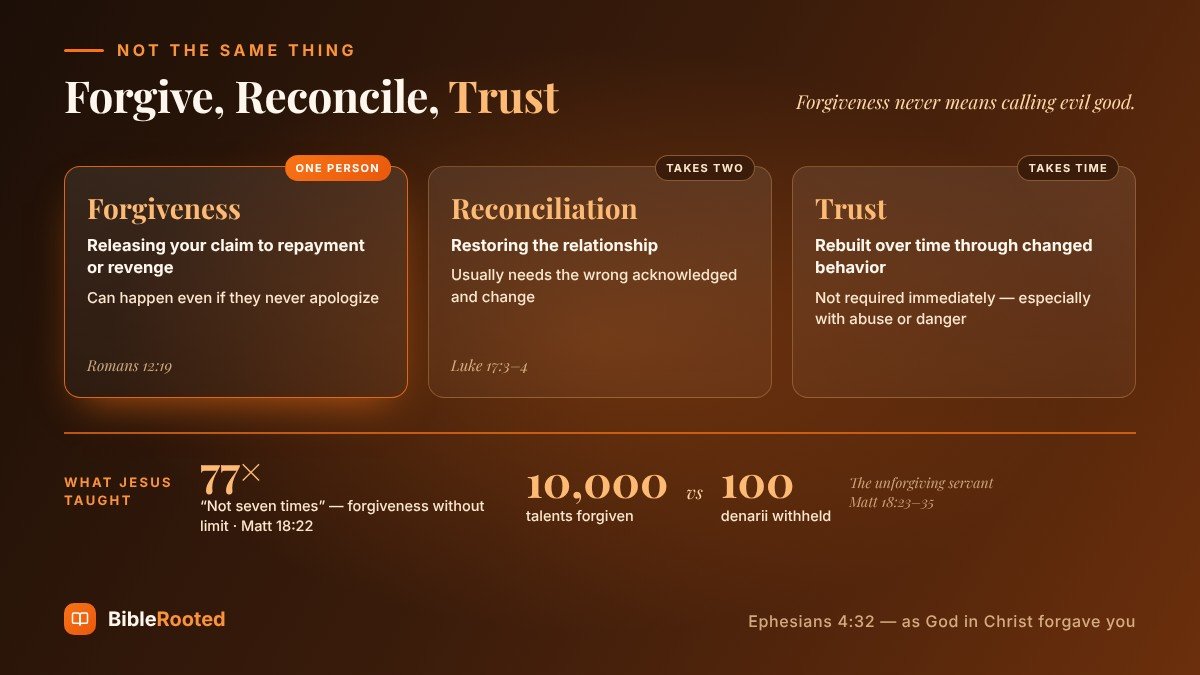
Seventy-seven times. When Peter asks if forgiving someone seven times is enough, Jesus answers, "Not seven times, but seventy-seven times" (Matthew 18:22; some translations say "seventy times seven"). The point isn't a new number to count to. It's limitless forgiveness, a reversal of Lamech's boast of seventy-sevenfold revenge in Genesis 4:24.
The parable of the unforgiving servant. Jesus then tells a story of a servant forgiven a debt of 10,000 talents, an unpayable fortune, who then refuses to forgive a fellow servant a debt of 100 denarii, roughly a few months' wages (Matthew 18:23-35). Those who've received enormous mercy are called to extend it.
Stories of forgiveness in the Bible
The Bible doesn't just teach about forgiveness. It shows it in action.
- Esau and Jacob. After Jacob cheats him out of his birthright and blessing, Esau plans to kill him. Twenty years later, Esau runs to meet Jacob, embraces him, and weeps (Genesis 33:4). Jacob says, "To see your face is like seeing the face of God."
- Joseph and his brothers. Joseph forgives the brothers who sold him into slavery and provides for their families (Genesis 45; 50:15-21).
- David and Saul. David spares Saul's life twice, even though Saul is trying to kill him, and refuses to take revenge (1 Samuel 24; 26).
- The prodigal son. In Jesus's parable, a father runs to embrace the son who wasted his inheritance, before the son can even finish his apology (Luke 15:20-24).
- Stephen. As he's being stoned to death, the first Christian martyr prays, "Lord, do not hold this sin against them" (Acts 7:60), echoing Jesus's prayer from the cross.
Forgiveness vs reconciliation vs trust
The Bible's call to forgive is often confused with other things. It helps to distinguish them.
- Forgiveness is releasing your claim to repayment or revenge. You hand the debt over to God, who judges justly (Romans 12:19). This can happen even if the other person never apologizes.
- Reconciliation is the restoration of the relationship. It takes two people, and it usually requires the wrongdoer to acknowledge the wrong and change (Luke 17:3-4).
- Trust is rebuilt over time through changed behavior. Forgiving someone doesn't require immediately trusting them again, especially in cases of abuse or danger.
Forgiveness also doesn't mean calling evil good or avoiding justice. The Bible takes wrongdoing seriously. Forgiveness means choosing not to repay evil with evil and trusting God to set things right.
Frequently asked questions
Do I have to forgive someone who isn't sorry?
Jesus calls his followers to release their desire for revenge and leave justice to God, even when the other person isn't sorry. But full reconciliation of the relationship normally requires repentance on their part (Luke 17:3).
Does forgiving mean forgetting?
No. Forgiveness doesn't erase memory. It means choosing not to hold the offense against the person. When the Bible says God "remembers sin no more," it means he no longer holds it against his people, not that he loses information.
Is there an unforgivable sin?
Jesus speaks of blasphemy against the Holy Spirit as unforgivable (Mark 3:28-30). In context, it refers to persistently attributing the Spirit's work in Jesus to Satan, a hardened rejection of God's offer of forgiveness itself.
Why is forgiveness so important in the Bible?
Because it reflects God's own character. God's people are called to show others the same mercy they've received, and forgiveness breaks cycles of revenge that tear communities apart.