
2 John is the shortest book in the Bible by verse count, 13 verses that would have fit on a single sheet of papyrus. The writer calls himself simply "the elder" and writes to "the elect lady and her children," most likely a local church and its members. His message has two halves. First, keep loving one another, which means living by God's commands. Second, watch out for traveling teachers who deny that Jesus Christ came in a real human body, and do not give them a place to stay or a platform in the church. In a world where Christian teachers moved from town to town and depended on believers' hospitality, that second instruction carried real weight. The letter shows truth and love working together: love without truth would welcome anyone, and truth without love would forget the command that runs through all of John's writing.
2 John at a glance
| Author | "The elder," traditionally the apostle John (1:1) |
|---|---|
| Recipients | The elect lady and her children, probably a church and its members (1:1) |
| Length | 1 chapter, 13 verses; about 245 words in Greek |
| Date and place | About AD 85–95, probably from Ephesus |
| Main theme | Walking in truth and love, and refusing support to false teachers |
| Key verse | Anyone who goes beyond Christ's teaching and does not remain in it does not have God (1:9) |
Who wrote 2 John, and why?
The writer never gives his name. He calls himself "the elder" (1:1), a word that can mean an older man or a church leader. 3 John opens the same way (3 John 1:1). The early church connected both letters to the apostle John, son of Zebedee. Irenaeus, writing around AD 180, quotes from 2 John and names John as its author. The wording is very close to 1 John: commands heard "from the beginning," walking in truth, loving one another, and the warning about deceivers who deny that Jesus came in the flesh (1:5-7; 1 John 4:2-3). The commentator Adam Clarke counted at least eight of the 13 verses that repeat ideas from 1 John almost word for word.
Not everyone agreed. The church historian Eusebius listed 2 and 3 John among the books some churches disputed, noting doubt over whether they came from the apostle or from another man named John. Eusebius also mentions a second leader in Asia called John the Elder, and some scholars, ancient and modern, have suggested he wrote these two letters. Others answer that an apostle in old age could naturally call himself the elder, as Peter called himself a fellow elder (1 Peter 5:1). By the end of the fourth century, both letters were accepted throughout the church.
Tradition places John in Ephesus during his last years, overseeing churches in the province of Asia. The letter probably dates from around AD 85–95, close to 1 John. A few scholars think 2 John came first and that 1 John expands on it; most think it followed.
The reason for writing is plain. Many deceivers had gone out into the world (1:7). In the first century, traveling preachers and missionaries moved from church to church and relied on believers to house and feed them. That system spread the gospel, but it also gave false teachers easy access. An early Christian manual called the Didache gives rules for testing such visitors, such as warning that a prophet who wants to stay more than a few days or asks for money is a fraud. John wrote to make sure this church did not open its doors to people spreading a false picture of Christ.
Who was the elect lady?
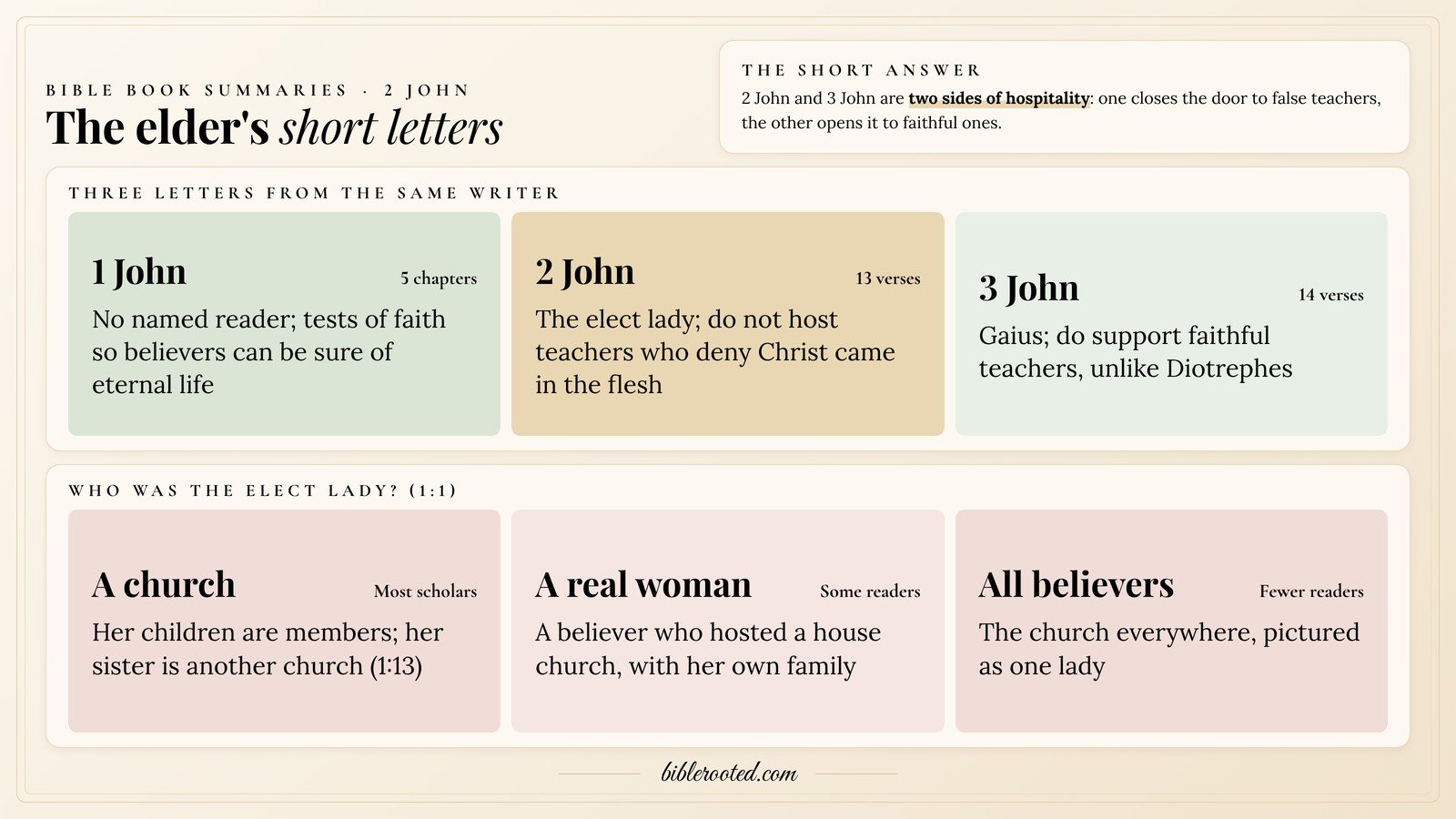
The letter is addressed to "the elect lady and her children" (1:1), and readers have debated the phrase since the early centuries. Three main views exist.
Some think she was a real woman, a believer who led or hosted a house church, with children of her own. A few have even taken one of the Greek words as her name, Electa or Kyria. On this view, the greeting from the children of her sister would come from her nephews and nieces (1:13).
Many more think the lady is a church, personified as a woman, and her children are its members. Scripture often pictures God's people as a woman or bride (Isaiah 54:6; Ephesians 5:25-27; Revelation 19:7). Several details support this. John says everyone who knows the truth loves her (1:1), which fits a congregation better than a private person. He switches between singular and plural "you" in the Greek. He says he found "some" of her children walking in truth (1:4). And the greeting from her "elect sister" in the final verse sounds like a sister church (1:13).
A third view sees the whole church everywhere addressed as one lady. Most readers find this less likely, since the letter speaks of a specific visit and a sister congregation. Whichever view is right, the message does not change.
How 2 John is structured
The letter follows the normal pattern of an ancient Greek letter: greeting, body and farewell. The word "truth" appears five times in the first four verses, and "love" four times in the letter.
| Section | Verses | Focus |
|---|---|---|
| Greeting | 1:1-3 | Love in the truth; grace, mercy and peace |
| Walking in love | 1:4-6 | Joy over faithful children; the old command to love |
| Warning about deceivers | 1:7-9 | Denying Christ in the flesh; staying in his teaching |
| No welcome for false teachers | 1:10-11 | Do not host or support them |
| Farewell | 1:12-13 | Hope to visit; greetings from a sister church |
1:1-3: love in the truth
The elder writes to the elect lady and her children, whom he loves in the truth. He is not alone: everyone who knows the truth loves them too, because of the truth that lives in believers and will stay with them forever (1:1-2). For John, truth is more than accurate facts. It is the reality of who Jesus is, which believers know and which lives in them, and it is what binds them together.
His blessing is confident. He says grace, mercy and peace will be with the readers, from God the Father and from Jesus Christ, the Father's Son, in truth and love (1:3). Calling Jesus "the Son of the Father" already points to the issue the letter will address: who Jesus really is. Mercy appears in the greetings of only a few New Testament letters, mostly the letters to Timothy (1 Timothy 1:2; 2 Timothy 1:2).
1:4-6: walking in love
John was overjoyed to find some of the lady's children walking in the truth, living in line with what the Father commanded (1:4). Many readers take "some" to mean only part of the church was faithful, while others say John simply met some of its members on their travels. Either way, his joy is a pastor's joy, which he expresses again in 3 John 1:4.
Then he makes his request. It is not a new command but the one they have had from the beginning: that we love one another (1:5). Jesus gave it to his disciples on the night before his death (John 13:34-35), and John repeats it throughout his first letter (1 John 3:11). He then defines love in a way that may surprise modern readers. Love means walking according to God's commands, and the command, as they heard from the beginning, is to walk in love (1:6). The two explain each other. Love is shown by obedience, and obedience is summed up in love. Jesus said much the same thing (John 14:15).
1:7-9: deceivers who deny the incarnation
This is the reason for the letter. Many deceivers have gone out into the world who do not acknowledge Jesus Christ as coming in the flesh. Anyone like that, John says, is the deceiver and the antichrist (1:7). The same charge appears in 1 John 2:22 and 1 John 4:3, and these are the only places in the Bible where the word antichrist is used. The deceivers probably held ideas later found in Gnosticism, which treated physical matter as evil. Some taught that Christ only seemed to have a body. Others separated the divine Christ from the human Jesus. John's wording may also stress that Jesus remains a real human being, raised bodily and coming again.
Readers must watch themselves so they do not lose what had been worked for, but receive a full reward (1:8). Some early manuscripts read "what you have worked for," others "what we have worked for," referring to the labor of John and his coworkers. Christians differ on whether this warning concerns salvation itself or rewards beyond it. Many say John means that true believers will persevere, and that those who fall away show they never truly belonged (1 John 2:19). Others read it as a real danger of losing what had been gained.
Anyone who "runs ahead" and does not remain in the teaching of Christ does not have God. Whoever remains in that teaching has both the Father and the Son (1:9). The Greek word suggests going beyond a boundary. The false teachers likely presented themselves as advanced thinkers who had moved past the simple message about Jesus. John says moving past Christ means leaving God behind.
1:10-11: no welcome for false teachers
If anyone comes to them without this teaching, they must not receive him into the house or greet him, because anyone who welcomes him shares in his evil work (1:10-11). These are the strongest words in the letter, and they raise real questions for readers today.
Most commentators note three limits. First, John is speaking of teachers who come to spread their message, not of ordinary people who hold mistaken beliefs. Second, the error concerns the heart of the faith, the identity of Jesus, not minor disagreements. Third, the "house" may well be the house church where believers met, so the issue is giving a false teacher a platform and financial support. The greeting John forbids was more than a hello; it was the public welcome that came with hospitality. Some readers think the instruction also limits private hospitality, while others see it only as a rule for church life. All agree John is not calling for hostility or persecution. 3 John shows the other side: believers should generously support teachers who carry the truth (3 John 1:5-8).
1:12-13: face to face
John says he has much more to write but would rather not use paper and ink. He hopes to visit and speak face to face, so their joy may be complete (1:12). The children of the lady's elect sister send greetings (1:13). If the lady is a church, her sister is the church where John was living, probably in Ephesus.
How 2 John compares with 1 and 3 John
The three letters share vocabulary and concerns, but each has its own focus.
| Letter | Written to | Main concern |
|---|---|---|
| 1 John | Churches in general; no named recipient | Assurance; tests of belief, obedience and love (1 John 5:13) |
| 2 John | The elect lady and her children | Do not host teachers who deny Christ came in the flesh (1:10) |
| 3 John | Gaius, a faithful believer | Do support faithful traveling teachers; Diotrephes refuses them (3 John 1:5-10) |
2 John section by section
Click any verse reference to read it.
| Verses | What they cover |
|---|---|
| 1:1-3 | Greeting from the elder; truth that lives in believers |
| 1:4-6 | Joy over faithful children; love as obedience |
| 1:7-9 | Deceivers deny Christ in the flesh; stay in his teaching |
| 1:10-11 | Do not host or greet false teachers |
| 1:12-13 | Hope to visit; greetings from a sister church |
Main themes of 2 John
Truth
The truth about Jesus lives in believers and binds them together (1:1-2).
Love as obedience
Love is walking by God's commands (1:6).
Christ in the flesh
Denying the incarnation is the mark of a deceiver (1:7).
Staying in Christ's teaching
Moving beyond it means losing God (1:9).
Discerning hospitality
Welcome is a form of partnership (1:10-11).
Lessons from 2 John
- Keep truth and love together. Each one shapes the other (1:3).
- Rejoice in faithfulness. John was glad to see believers living well (1:4).
- Measure love by obedience. Feelings alone do not define it (1:6).
- Know who Jesus is. The incarnation is not optional (1:7).
- Be careful what you support. Hospitality can spread error (1:10-11).
Frequently asked questions
What is the main message of 2 John?
Walk in truth and love, and do not welcome or support teachers who deny that Jesus Christ came in the flesh (2 John 1:4-7; 2 John 1:10-11).
What is the main point of the letter of 2 John?
Love and truth belong together: love means obeying God, and truth means staying in Christ's teaching (2 John 1:6; 2 John 1:9).
What are the differences between 1 John and 2 John?
1 John is a longer general letter about assurance and tests of faith. 2 John is a short personal letter to one church that applies the same warning to a concrete question: whether to host traveling teachers (1 John 5:13; 2 John 1:10).
How can I apply 2 John to my life?
Love others by living God's way, learn the truth about Jesus well, and think carefully about which teachers and ministries you support (2 John 1:6; 2 John 1:9-11).
Who is the elect lady in 2 John?
She may have been a real Christian woman and her family, but most scholars think the phrase describes a local church and its members, with the elect sister as another church (2 John 1:1; 2 John 1:13).
What is the most quoted verse in 2 John?
Many readers point to the definition of love as walking by God's commands (2 John 1:6) or the warning about deceivers who deny Christ came in the flesh (2 John 1:7).