Prayers of the Bible · Matthew 6 · Luke 11
The Lord's Prayer, line by line
Short answer: The Lord's Prayer is the model prayer Jesus taught in Matthew 6:9–13 and Luke 11:2–4. It opens by addressing God as Father, makes seven requests and ends in praise. The first three requests ask for God's glory ("thy name, thy kingdom, thy will"); the last four ask for our needs.
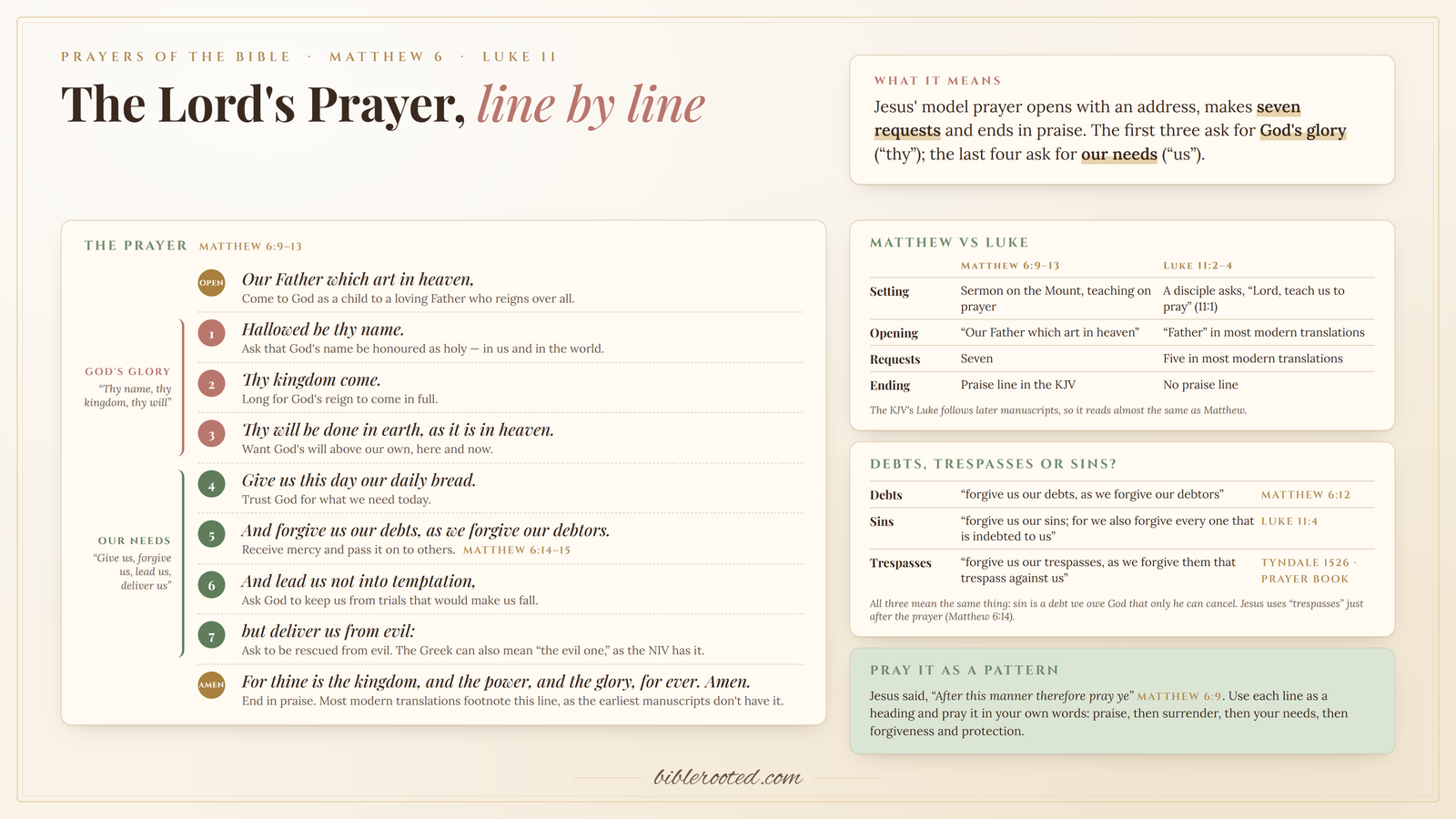
The infographic in text form
The prayer and what each line means
| Part | Line (Matthew 6:9–13, KJV) | Meaning |
|---|---|---|
| Address | Our Father which art in heaven, | Come to God as a child to a loving Father who reigns over all. |
| 1 · God's glory | Hallowed be thy name. | Ask that God's name be honoured as holy, in us and in the world. |
| 2 · God's glory | Thy kingdom come. | Long for God's reign to come in full. |
| 3 · God's glory | Thy will be done in earth, as it is in heaven. | Want God's will above our own, here and now. |
| 4 · Our needs | Give us this day our daily bread. | Trust God for what we need today. |
| 5 · Our needs | And forgive us our debts, as we forgive our debtors. | Receive mercy and pass it on to others (Matthew 6:14–15). |
| 6 · Our needs | And lead us not into temptation, | Ask God to keep us from trials that would make us fall. |
| 7 · Our needs | but deliver us from evil: | Ask to be rescued from evil. The Greek can also mean "the evil one", as the NIV has it. |
| Praise | For thine is the kingdom, and the power, and the glory, for ever. Amen. | End in praise. Most modern translations footnote this line, as the earliest manuscripts don't have it. |
Matthew vs Luke
| Matthew 6:9–13 | Luke 11:2–4 | |
|---|---|---|
| Setting | The Sermon on the Mount, in teaching on prayer | A disciple asks, "Lord, teach us to pray" (11:1) |
| Opening | "Our Father which art in heaven" | "Father" in most modern translations |
| Requests | Seven | Five in most modern translations |
| Ending | Praise line in the KJV | No praise line |
The KJV's Luke follows later manuscripts, so in that translation it reads almost the same as Matthew.
Debts, trespasses or sins?
- Debts: "forgive us our debts, as we forgive our debtors" Matthew 6:12
- Sins: "forgive us our sins; for we also forgive every one that is indebted to us" Luke 11:4
- Trespasses: "forgive us our trespasses, as we forgive them that trespass against us" Tyndale (1526) · Book of Common Prayer
All three mean the same thing: sin is a debt we owe God that only he can cancel. Jesus uses "trespasses" just after the prayer (Matthew 6:14).
Read the passages
Keep exploring on Bible Rooted
Share this infographic

You're welcome to share this infographic on your website, blog, social media, church slides or printed handouts, free of charge. Please credit Bible Rooted and link back to this page. See the full terms.


